Targeted Financial Sanctions matter with AMLR
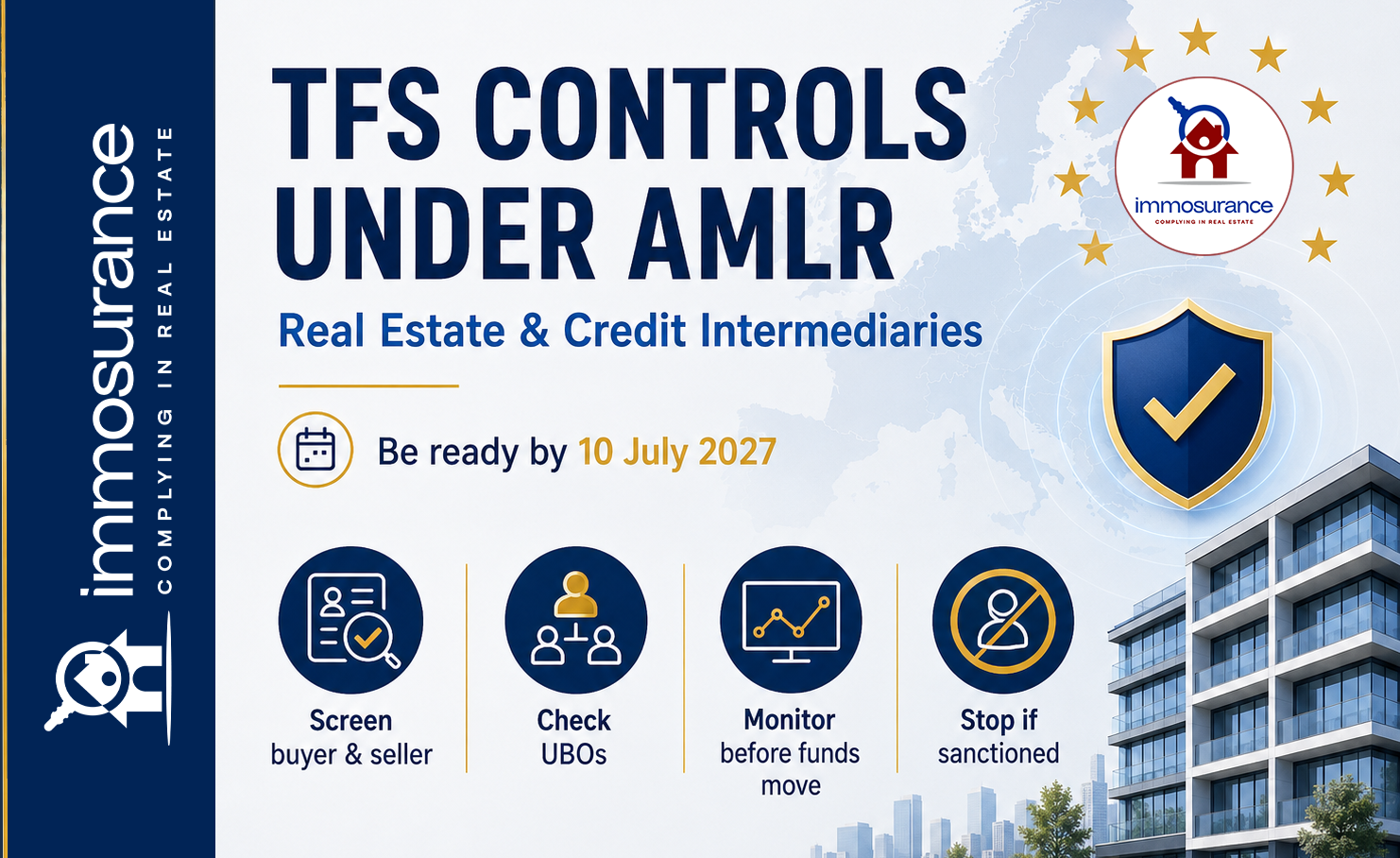
The upcoming EU Anti-Money Laundering Regulation (AMLR), which officially takes effect on July 10, 2027, represents a monumental shift for both real estate agents (REAs) and mortgage credit intermediaries.
Under the AMLR "Single Rulebook," the prevention of the non-implementation or evasion of Targeted Financial Sanctions (TFS) has been introduced as an explicit, core legal objective. Businesses that historically viewed sanctions screening as something "only banks do" must now implement strict TFS controls.
1. Impact on Real Estate Agents (REAs)
The AMLR shifts from a "profession-based" scope to an activity-based scope, pulling more property-related businesses into the regulatory net.
Broader Scope (Including Lettings & Developers): The rules apply to any "real estate operator" acting as an intermediary in buying or selling. Furthermore, high-end rental letting is now firmly in scope for any tenancy where the monthly rent is €10,000 or more. Property developers selling directly to investors are also fully captured.
Mandatory TFS Screening: Agents must screen both the buyer and the seller against EU and UN sanctions lists. You cannot rely on the notary or the bank to do it for you.
Strict Timing Requirements: Identity verification and TFS checks must be completed after the acceptance of an offer but before any transfer of funds occurs.
The "Franchise" Game Changer: Large real estate networks and franchise structures must implement group-wide AML/TFS policies, controls, and training across their entire network of independent offices.
2. Impact on Mortgage Credit Intermediaries
For many mortgage brokers, the AMLR marks their official debut as fully regulated "Obliged Entities" across the EU.
Newly Regulated Sector: Unless already covered under existing strict national financial laws, mortgage and consumer credit intermediaries are now explicitly subject to the Single Rulebook.
Shift to "Activity Monitoring": The newly formed European AML Authority (AMLA) is pushing guidelines that mandate pre-transaction and real-time monitoring. As an intermediary, you must monitor a client's behaviors and documents in real-time before passing the loan file to a lender.
Asset/Sanction Linkage: If a borrower is attempting to secure a mortgage using funds linked to a designated person (TFS target), or if the property being put up as collateral belongs to a sanctioned individual, the broker must block the transaction and freeze the process immediately.
Common Risks and Ultimate Beneficial Ownership (UBO)
Because real estate is a primary vehicle for hiding wealth, the AMLR heavily targets shell companies used to buy property.
The 25% Threshold: When dealing with corporate clients buying property or taking out a mortgage, agents and intermediaries must identify the Ultimate Beneficial Owners (UBOs) holding 25% or more of the shares/voting rights.
The TFS Trap: If a shell company owns a property, and a sanctioned individual owns just 25% of that shell company, the entire company is restricted under TFS rules. Real estate agents and mortgage brokers who fail to dig down to the true UBO and proceed with the deal face devastating corporate fines and personal liability under the AMLR.
Learn how Immosurance covers all these and many other relevant aspects of this ever more complicated legislation which is shocking the non-financial sector in particular. Preparing for AMLR takes time and the right partner. Start today and be ready before crunch time...the closer to D-day, the scarcer the resources and the higher the stress levels!