AMLR INSIGHT • BENEFICIAL OWNERSHIP
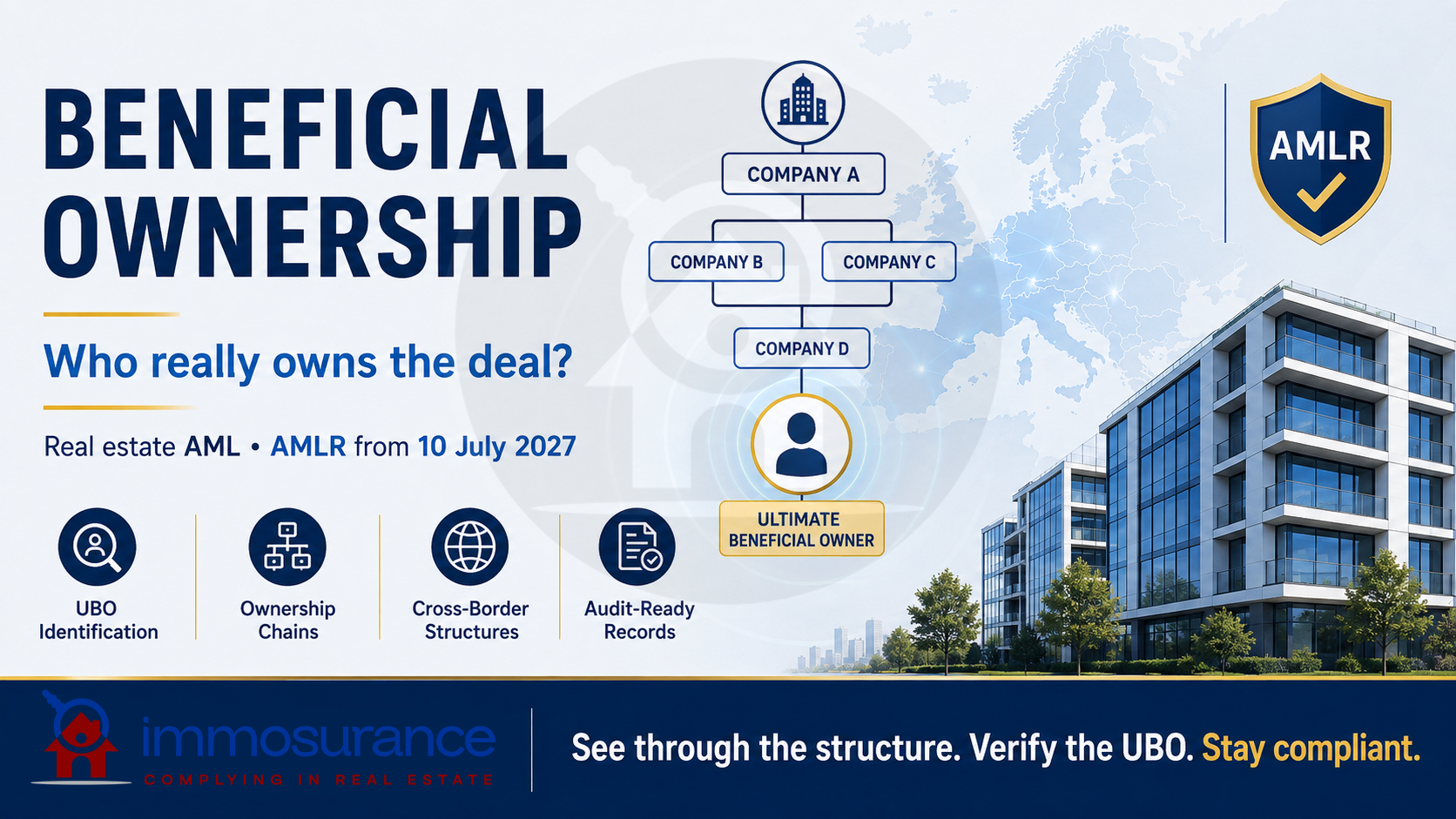
Who Really Owns the Deal?
Beneficial ownership complexity in real estate — and what the EU’s new Anti-Money Laundering Regulation means for the property sector
Every property transaction eventually comes down to a simple question with a surprisingly difficult answer: who really owns the company on the other side of the deal? Criminals rarely operate under their own name. They hide behind layers of corporate structures, nominee directors, and cross-border arrangements — which is exactly why beneficial ownership has become one of the most critical, and most complex, questions in anti-money laundering (AML) compliance today.
Real estate is a preferred vehicle for laundering illicit funds: transactions are high-value, assets hold their worth, and ownership can be obscured behind holding companies and trusts spread across several jurisdictions. For estate agents, notaries, conveyancers, developers, and property investors, identifying the Ultimate Beneficial Owner (UBO) is no longer a box-ticking formality — it is the point at which the real money-laundering risk is either exposed or missed entirely.
Why beneficial ownership matters in real estate
Beneficial ownership reveals who ultimately owns or controls a company — the natural person who is really behind the legal entity signing the contract. Without identifying that person, the true risk profile of a counterparty stays hidden. In practice, launderers rely on three recurring techniques:
– Complex, layered corporate structures that stretch ownership across multiple tiers of companies.
– Nominee shareholders or directors who appear on paper while the real owner stays invisible.
– Cross-border ownership arrangements that exploit gaps between national registers and reporting standards.
For property professionals, the consequence is direct: if you cannot see through the structure to the individual who owns and benefits, you cannot properly assess the risk of the transaction you are facilitating — and you carry the regulatory exposure that comes with it.
What is changing: the EU AML Regulation from 10 July 2027
The EU Anti-Money Laundering Regulation (AMLR, Regulation (EU) 2024/1624) becomes directly applicable across all Member States on 10 July 2027 — with no national transposition required, giving it immediate and harmonised effect. Real estate agents and other property professionals fall squarely within its scope of obliged entities. For beneficial ownership, three things change in a way that matters for everyday due diligence.
1. A harmonised, mandatory minimum dataset
Today, the beneficial ownership data collected across Europe varies from country to country. Some information — place of birth, tax identification number (TIN), full residential address, and details of the senior managing official — is required in some jurisdictions but remains only a local practice in others. The result is limited comparability and added complexity when determining who the UBO actually is. From 2027, the AMLR sets a harmonised minimum dataset that every Member State must collect (legal basis: Art. 62(1)(a) AMLR), making cross-border checks far more consistent.
2. A lower, sharper ownership threshold
The participation threshold that triggers beneficial ownership tightens. It moves from more than 25% to 25% or more (Art. 51(1)(a), Art. 52 AMLR) — a subtle shift that pulls exactly-25% holdings into scope. For entities the Commission designates as high-risk, the threshold can drop to 15% or lower (Art. 52(2) AMLR). Ownership and control must always be assessed together, never in isolation.
Threshold at a glance
Standard ownership: currently > 25% → under AMLR ≥ 25%
High-risk entities: ≤ 15% (and, where applicable, < 25%) — as determined by the Commission
Control via ownership interest: threshold > 50% (Art. 53(1) AMLR)
3. Three analytical principles now govern the assessment
The question is no longer simply “who holds the shares?” It is “who ultimately owns, controls, and benefits?” To answer it, the AMLR defines three analytical principles that must be applied together.
Who is the beneficial owner? Ownership and control
From an AML/CFT perspective, two routes lead to beneficial ownership, and both must be examined. BO through ownership arises from equity participation — meeting the 25% threshold (Art. 51(1)(a), Art. 52 AMLR). BO through control arises either from a controlling ownership interest above 50% (Art. 51(1)(b) first alternative, Art. 53(1) AMLR) or through control exercised by other means — voting agreements, veto rights, or similar mechanisms (Art. 51(1)(b) second alternative, Art. 53(2) et seq. AMLR). A person can be a UBO through control even while holding a small equity stake, or none at all.
The three principles for determining beneficial ownership
Principle 1 — Attribution (mathematical attribution of indirect holdings)
Shares, voting rights, and other ownership interests are multiplied along each ownership chain, and the results across all chains are then aggregated. A person who appears minor at first glance can cross the threshold once every indirect route is added together.
Practical example — Attribution
Person B holds interests through two separate chains into the same target company:
Chain A: 50% × 60% × 93% × 48% ≈ 13.39%
Chain B: 50% × 45% × 100% × 52% ≈ 11.70%
Aggregated: 13.39% + 11.70% ≈ 25.09% → Person B = UBO (beneficial ownership through equity participation).
Principle 2 — Control (assessment of influence)
Control can flow from direct or indirect ownership — requiring more than 50% of shares, voting rights, or other interests at each level — or through other means: influence exercised by alternative mechanisms such as shareholder agreements.
Practical example — Control
Three individuals hold a target company: Person E (20%), Person F (20%), and Person G (60%).
Persons E and F have a voting agreement, so they act in concert.
Result: E and F qualify as beneficial owners despite holding under 25% each. The UBOs are Persons E, F, and G.
Principle 3 — Combination (ownership and control assessed together)
In multi-tier structures, ownership and control can exist at the same time across different levels of one or more chains. Assessing them separately would miss the beneficial owner; assessing them together reveals the person.
Practical example — Combination
Attribution alone: Person H holds 60% of a holding company, which holds 40% of the target → 60% × 40% = 24% (below the threshold).
However: the holding company holds a direct interest of ≥ 25% in the target and is controlled by Person H (e.g. majority voting rights via a participation agreement).
Result: Person H = UBO. Combining ownership and control produces the correct answer where attribution alone does not.
KYC and beneficial ownership: what real estate professionals must do
The practical response is to align Know Your Customer (KYC) processes with the new regime well before it applies. Four actions matter most:
– Assess your KYC processes for beneficial ownership identification and verification against the new data requirements.
– Identify the relevant data sources — beneficial ownership registers, commercial databases, and reliable corporate records.
– Adapt the KYC process — the onboarding journey, KYC forms, policies and procedures, and controls.
– Remediate existing files to ensure AMLR compliance on beneficial ownership — remediation owned by the first line, oversight by the second.
Position yourself ahead of 2027
Beneficial ownership sits at the heart of AML compliance in real estate, and the AMLR raises both the bar and the stakes. The firms that treat the run-up to 2027 as preparation time — mapping ownership structures, tightening onboarding, and training their teams to think in terms of ownership and control — will carry far less risk than those that wait. Now is the time to position yourself strategically, well ahead of 2027.
immosurance — AML insight for the real estate sector
This article is provided for general information only and does not constitute legal or compliance advice. Article references are to Regulation (EU) 2024/1624 (AMLR). Illustrative examples are simplified.