Obligated Entities in Real Estate
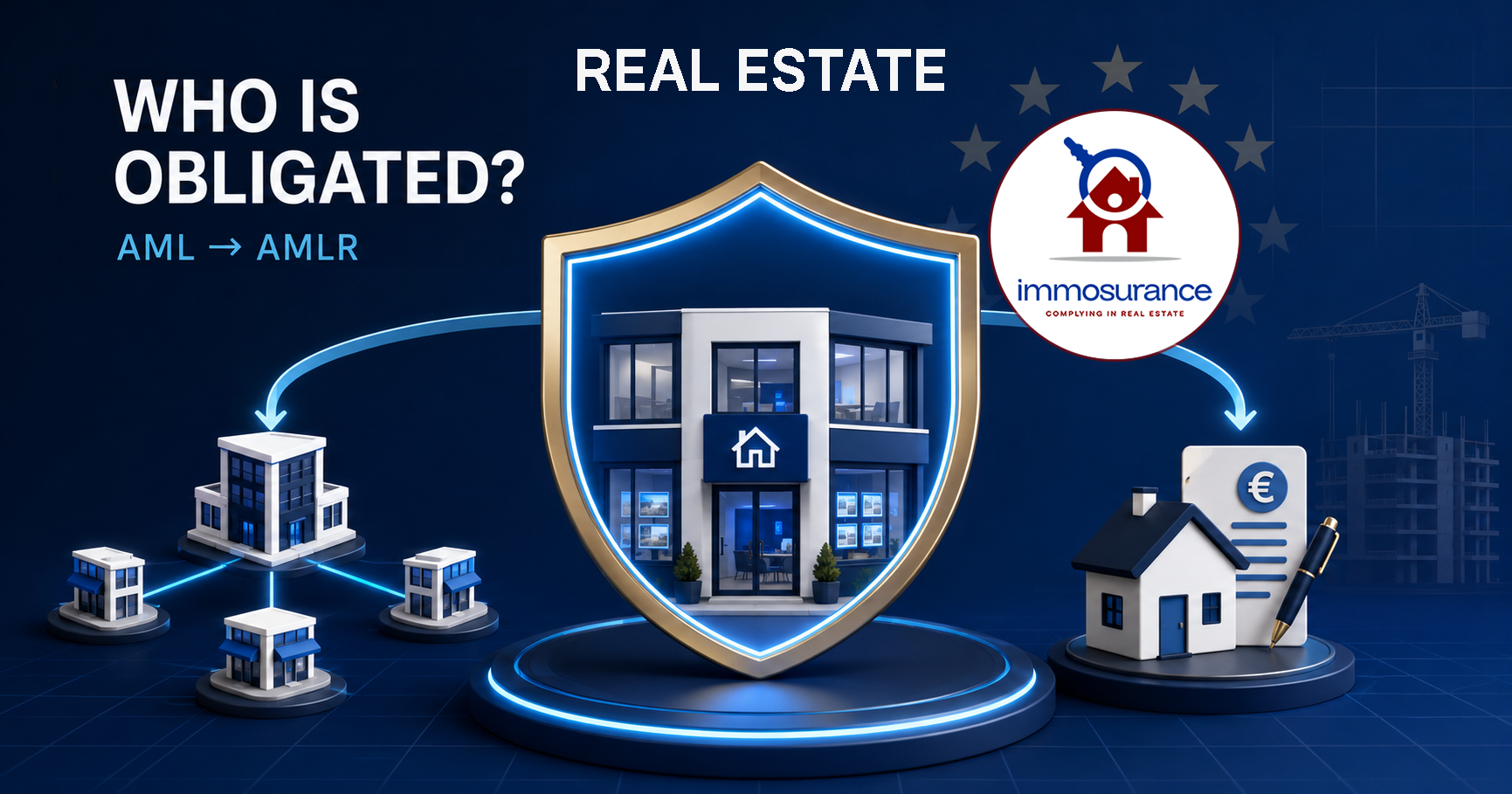
There is still remarkable confusion among real estate professionals about a question that should have been settled long ago: who exactly is obliged to apply anti-money laundering rules in a real estate transaction? With the EU's new AML Regulation (AMLR) applying from 10 July 2027, getting this wrong is about to become far more expensive. So let's clear it up — first for today's rules, then for the world of AMLR.
The rules today: agents in, developers out
Real estate agents have been obligated entities under EU AML law since December 2001 — a quarter of a century. Property developers (promotors), on the other hand, are not.
That distinction produces a result many find counter-intuitive: when a developer sells a new-build property to a client introduced by an agency, the agency carries the AML obligations — not the developer. Regardless of who actually signs as seller, the agency must identify the client, verify identity, and perform due diligence exactly as it would for a resale property. The party "flying the flag" on the transaction is not necessarily the party the law holds responsible.
The same logic applies to franchise networks. Under the current Directive, a franchisor with no direct ownership of its franchisees is not an obligated entity. Each individual franchisee is, in its own right — with its own risk assessment, its own procedures, its own reporting duties.
Why so many still don't know
How can facts that have stood for 25 years still surprise seasoned professionals? Three reasons: decentralised supervision spread across national authorities; a Directive that each Member State transposed — and interpreted — its own way; and, frankly, a chronic shortage of audits from national FIUs. For much of the sector, AML compliance has been a theoretical obligation, policed lightly, applied unevenly.
That era of flying below the radar is ending — abruptly.
What changes under AMLR: from directive to single rulebook
AMLR (Regulation (EU) 2024/1624) is not another directive to be transposed and diluted 27 different ways. It is a directly applicable Regulation — a single rulebook binding every Member State identically. It tightens the obligations of everyone already in scope: due diligence must now be demonstrable, file by file, not merely described in a policy binder. And it deliberately widens the circle of obligated entities.
For the real estate sector, three changes stand out:
1. Scope becomes activity-based. AMLR speaks of "real estate operators" intermediating the buying, selling and letting of immovable property — regardless of their designation or principal business. That explicitly includes property developers when and to the extent they intermediate transactions, and it pulls high-end letting into scope (intermediation of rentals with a monthly rent of €10,000 or more). The old comfortable categories are gone; what you do determines whether you are obliged.
2. Franchise structures face group-wide obligations. This is the true game changer. AMLR's group-wide requirements (Article 16) reach beyond classic parent-subsidiary groups to networks, partnerships and structures with shared ownership, management or compliance control — AMLA is finalising the technical standards on exactly this right now. Franchisors who spent two decades outside the perimeter must now design, roll out and monitor consistent AML policies, controls and training across their entire network. For most franchise head offices, this is an entirely new discipline — and a complex one.
3. Mortgage brokers join the club. Mortgage credit intermediaries become obligated entities in their own right for the first time. They have one real advantage: their way of working is already largely digital. With the right, exhaustive digital solution, their adaptation will be less brutal than what awaits paper-based agencies and franchisors. But "new to AML" also means no procedures, no trained staff, no reporting reflexes — and only months to build all three.
AMLA changes the enforcement equation
The new Anti-Money Laundering Authority (AMLA), operational in Frankfurt since 2025, was not created merely to write the rulebook. It sits above the national supervisors and FIUs, with an explicit mandate to drive convergence and strict adherence. Translation: once AMLR applies, expect a serious surge in audits — coordinated, consistent, and no longer dependent on the appetite of a local regulator.
Combine that with elevated fines under the new framework, and the arithmetic becomes uncomfortable for anyone who has been coasting. Businesses that weren't vigilantly applying their existing obligations will find the climb to AMLR compliance long and hard. Some, inevitably, will not survive it. That is not scaremongering; it is what happens in every sector when a lightly-policed obligation suddenly acquires a supervisor with teeth.
The clock — and the talent — are running out
One more factor is routinely underestimated: capacity. The closer we get to July 2027, the busier AML experts, consultants and implementation teams will be — and the scarcer that competence becomes. Prices go up, timelines stretch, and latecomers queue. The firms that start now choose their solution calmly; the firms that start in 2027 take whatever is left.
Start today — with a solution built for exactly this
This is precisely why we built Immosurance: the first European-wide AML compliance solution designed specifically for the real estate sector, developed in collaboration with CEPI, Europe's leading real estate association.
Immosurance is genuinely all-in-one and exhaustive: Know Your Business (company self-assessment, internal AML policies, employee training, whistleblowing channel), Know Your Customer (digital ID verification, sanctions and PEP screening, adverse media monitoring) and real-estate-specific risk assessment — in one place, in 14+ languages, for a single agency or an entire franchise network. Every CDD and EDD step is securely documented with instant auditability — exactly the file-by-file demonstrability AMLR demands, and exactly what an AMLA-driven audit will ask for.
And because compliance cannot come at the price of privacy: Immosurance is secure and GDPR-compliant by design — encrypted, role-based access, EU-grade data protection — and AMLR-ready, so the transition in 2027 is an update, not an upheaval.
The obligated-entity perimeter is widening. Supervision is centralising. Fines are rising. Whether you are an agency that has carried this duty for 25 years, a franchisor about to carry it for the first time, or a mortgage broker starting from zero — the smartest money in real estate right now is the money spent on getting compliant before the rush.
The radar is switching on. Make sure you're ready to be seen.
Are you an agent, franchisor or mortgage broker preparing for AMLR? Reach out to see what Immosurance can take off your plate.