AML Regulations Around the World
Somewhere between 2 and 5 percent of global GDP — roughly $800 billion to $2 trillion — is laundered every year, according to the UN Office on Drugs and Crime. Residential Real Estate remains the favourite vehicle for criminals to laundry their dirty money. What has changed is not the scale of the problem. It’s the speed at which regulators are responding to it.
Over the past twenty-four months, nearly every major jurisdiction has rewritten, restructured, or radically extended its anti-money laundering framework. If you lead compliance, risk, or financial crime prevention anywhere in the world, here is the landscape you’re now operating in — region by region — and what I believe it tells us about where AML is heading.
Europe (EMEA): from directives to a single rulebook, especially impacting Real Estate businesses who have been flying under the radar for 25 years
For decades, EU AML law meant directives (AMLD 4, 5, 6) transposed unevenly across 27 member states. That era is ending. The EU’s 2024 AML package replaces fragmentation with a directly applicable Single Rulebook (AMLR) and a brand-new supervisor: the Anti-Money Laundering Authority (AMLA), operational in Frankfurt since July 2025. The approved AMLR single rulebook comes into effect on July 10th, 2027, less than one year from now, rapidly closing the window for business to prepare for the biggest paradigm shift on AML since the real estate businesses became obliged entities in December 2001.
The headline changes: a harmonised EU-wide €10,000 cash payment cap, a tightened beneficial ownership threshold (25% or more, with scope to drop to 15% for high-risk sectors), crypto-asset service providers fully in scope, and AMLA directly supervising roughly 40 of the highest-risk cross-border institutions from 2028 — with fining powers up to 10% of group turnover. The full rulebook applies from 10 July 2027. Europe is betting that consistency, not just stringency, is what defeats money laundering.
United Kingdom: enforcement with teeth, reform in motion
The UK still runs on the Money Laundering Regulations 2017 and the Proceeds of Crime Act 2002, but the ground is shifting. The Economic Crime and Corporate Transparency Act brought a new failure to prevent fraud offence into force in September 2025, and Companies House identity verification for directors and beneficial owners completes its rollout in November 2026. The 2026 amendments to the MLRs tighten crypto due diligence, and the government has confirmed the FCA will become the single AML supervisor for professional services — a major consolidation.
The enforcement signal is unmistakable: Starling Bank (£29m, 2024) and Monzo (£21m, 2025) were fined not for what they did, but for controls that failed to scale with growth. In the UK, growing fast is no longer a mitigating circumstance.
United States: deregulation on paper, aggression in practice
The US presents the most paradoxical picture. The Bank Secrecy Act, PATRIOT Act, and AML Act of 2020 remain the backbone — CIP, SARs, CTRs, OFAC sanctions screening. But the Corporate Transparency Act was dramatically narrowed in 2025: domestic US companies no longer file beneficial ownership reports, leaving only foreign entities in scope. The investment adviser AML rule slipped to 2028, and FinCEN’s April 2026 proposal would refocus program rules on “significant or systemic” failures.
Yet enforcement has never hit harder. TD Bank’s $3.1 billion resolution in late 2024 — including the first-ever bank guilty plea to money laundering conspiracy — and FinCEN’s unprecedented “fentanyl orders” cutting Mexican institutions off from the US financial system show a regime that is deregulating process while escalating consequences. Rules may be lighter; failure is more expensive than ever.
Canada: the quiet acceleration
FINTRAC has spent two years transforming from a modest FIU into a muscular supervisor. New sectors — factoring, cheque cashing, leasing and financing — became reporting entities in April 2025. A new administrative penalty framework landed in March 2026, and the Strong Borders Act proposes a criminal ban on cash payments of C$10,000 or more, with penalties reaching into the tens of millions. After FINTRAC’s record C$9.2m penalty against TD Bank Canada drew unflattering comparisons with the US response, Canada’s enforcement blitz has topped C$200m. The real test arrives this autumn: publication of Canada’s FATF mutual evaluation, discussed at the June 2026 plenary.
Asia-Pacific: fragmented rules, converging direction
APAC has no single regime — MAS in Singapore, HKMA in Hong Kong, RBI in India, JFSA in Japan — but the direction of travel is remarkably aligned: digital-first KYC (India’s video-KYC and Aadhaar-based onboarding, Singapore’s Singpass), tighter beneficial ownership rules, and rapid extension of AML obligations to digital assets.
Hong Kong’s Stablecoins Ordinance, live since August 2025, came with a dedicated AML/CFT guideline for issuers — a sign that in APAC, crypto regulation and AML regulation are now the same conversation.
Australia: the tranche 2 moment has arrived
This is the region’s biggest story. On 1 July 2026 — days ago — Australia’s AML/CTF reforms extended to lawyers, accountants, real estate agents, and dealers in precious metals and stones, bringing an estimated 80,000–100,000 new reporting entities under AUSTRAC’s supervision. Existing entities transitioned to updated obligations in March 2026.
Australia closed the “gatekeeper gap” two decades after the original Act, motivated in no small part by an enforcement history that includes Westpac’s A$1.3 billion penalty and the casino scandals. Any professional services firm in Australia that hasn’t enrolled with AUSTRAC is now late.
Singapore: the price of being a wealth hub
Singapore’s S$3 billion money laundering case of 2023 reshaped its regime. In July 2025, MAS penalised nine financial institutions a combined S$27.45 million — its largest AML action since 1MDB — for weak source-of-wealth corroboration and monitoring gaps. But the more consequential response was structural: COSMIC, the world’s first regulator-built platform for banks to share customer risk information, launched in 2024 and expanding toward mandatory sharing. Singapore’s May 2026 FATF evaluation confirmed a robust framework while flagging beneficial ownership verification as unfinished business. The lesson: reputation as a clean financial centre is earned continuously, never banked.
The global standard: FATF resets the scoreboard
Above it all sits the FATF. Its blacklist remains Iran, North Korea and Myanmar; the grey list — 22 jurisdictions after the June 2026 plenary — added Bosnia and Herzegovina and Iraq while releasing Algeria and Namibia. Notably, eight countries including South Africa and Nigeria have exited since early 2025: grey-listing increasingly works as a reform accelerator, not just a sanction. The new UK presidency has made fraud and scam networks its top priority — recognition that an estimated $51 billion in scam-linked crypto flows moved in 2024 alone.
The global AML direction is unmistakable
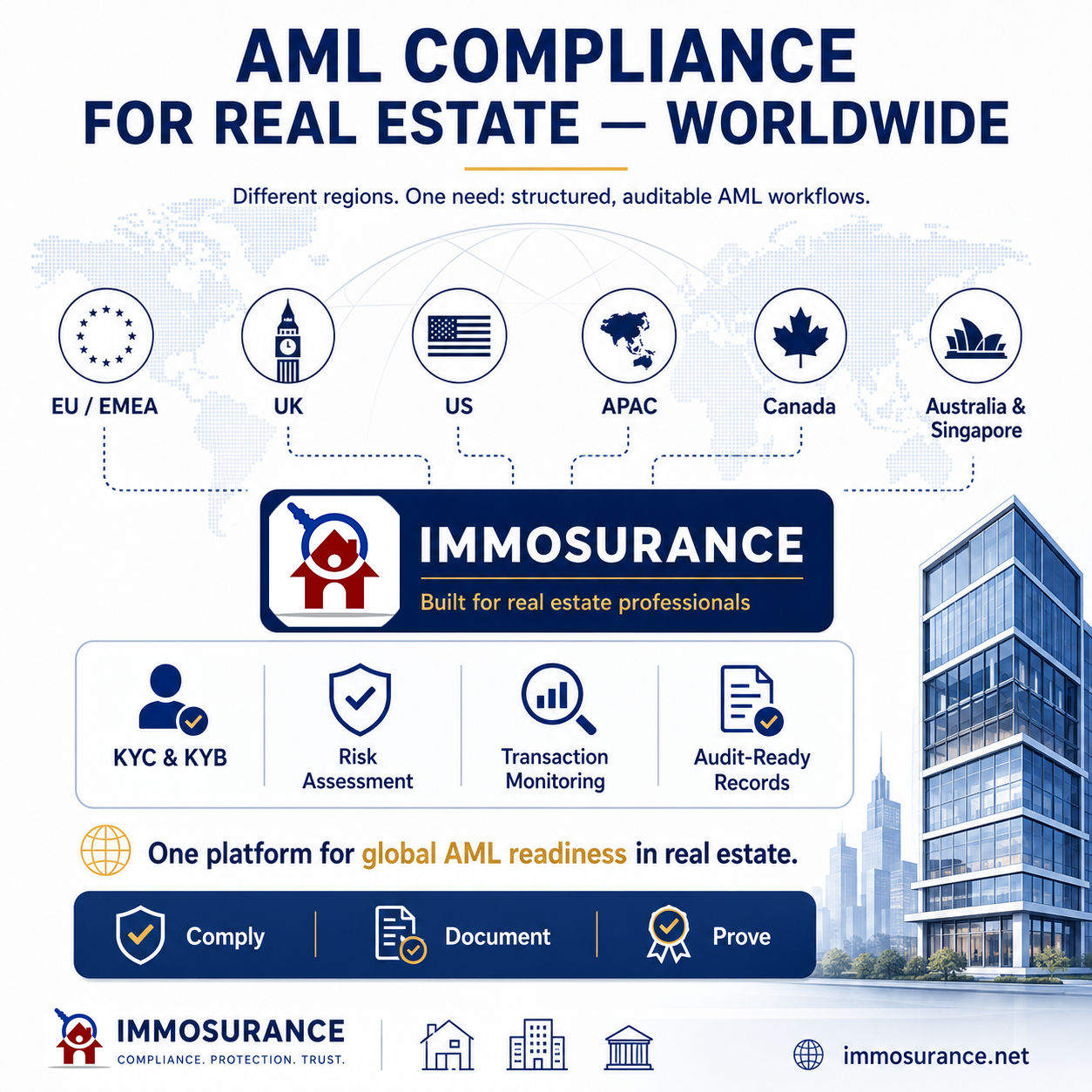
Across EMEA, APAC, the UK, the US, Canada, Australia, and Singapore, the details differ. But the trend is the same. This is where Immosurance will lead the way integrating on a global scale.
Real estate businesses must know:
who their customer is;
who ultimately owns or controls the customer;
where the money comes from;
whether the transaction makes economic sense;
whether the customer or transaction creates heightened risk;
when a suspicious activity report must be filed;
how to prove every compliance decision afterwards.
For real estate professionals, the future of AML is not a folder of documents collected at onboarding. It is a structured, documented, risk-based process that follows the client and the transaction from first contact to completion — and, where relevant, beyond. Auditability becomes instant: only a central and secure solution is able to cope with this.
What this all means
Three convictions I take from mapping these eight regimes side by side.
Convergence is real. Beneficial ownership registries, crypto travel rules, risk-based supervision — the same architecture is being assembled everywhere, at different speeds. A multinational compliance program built to the strictest common denominator is no longer gold-plating; it’s efficiency.
The perimeter is expanding faster than the technology. Lawyers in Sydney, real estate closers in Miami, leasing companies in Toronto — millions of professionals are becoming AML gatekeepers for the first time. The next enforcement wave will land there.
Collective defence is replacing solo compliance. COSMIC in Singapore, FIU coordination under AMLA, public-private data sharing in the UK — the walls between institutions are coming down, because criminals never respected them anyway.
Different regions, one goal. The regulators have made their move. The question for every board is whether their compliance function is resourced for the world of 2027 — or the world of 2017.
Initiatives emerge such as Immosurance (read at immosurance.net), precisely providing an international compliance solution targeting the Real Estate industries with its multi-aspects. Covering Real Estate Brokers, Promotors, and Real Estate Mortgage Brokers alike.