AMLR vs. AMLD6: What Every Real Estate Business in Europe Must Do
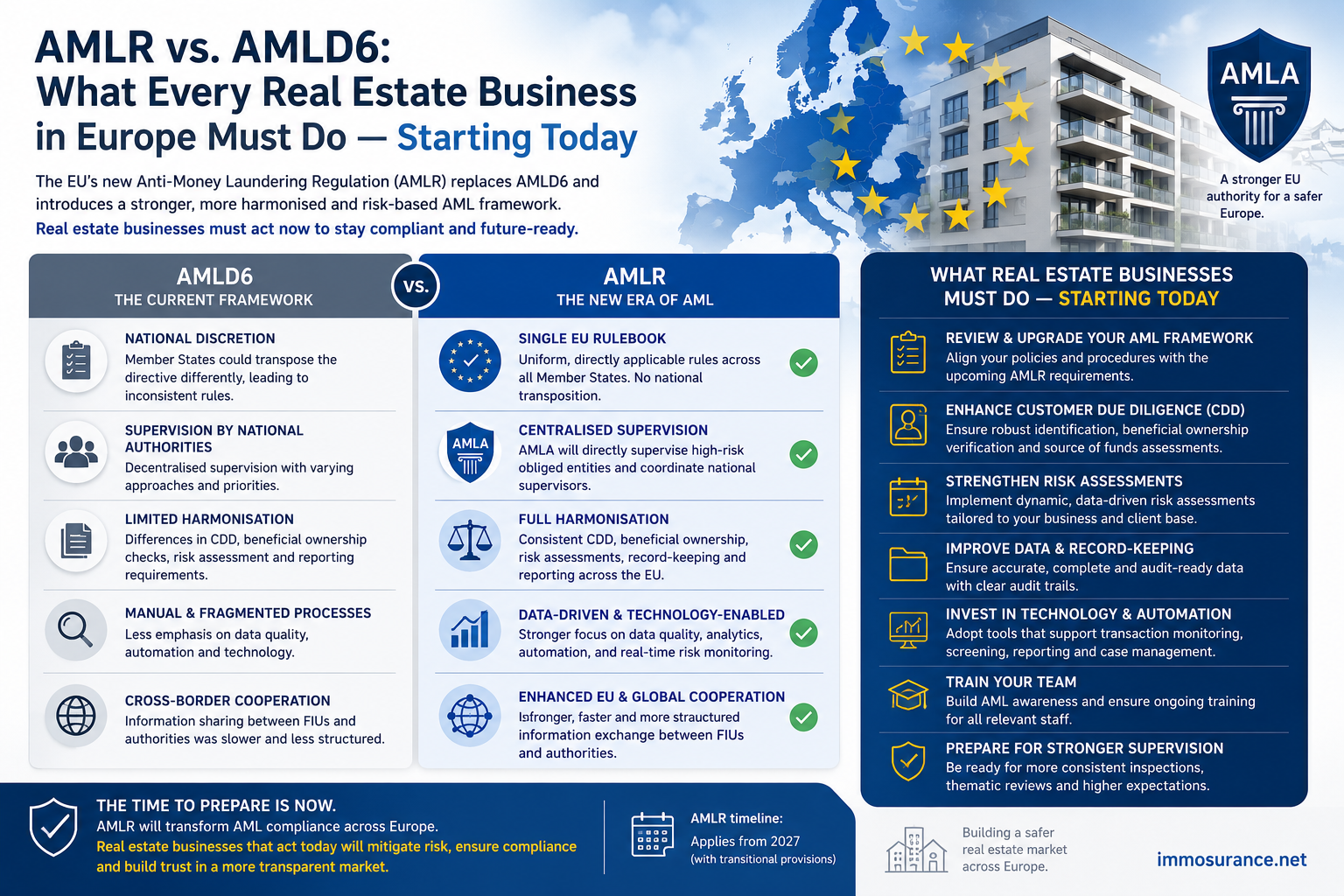
The EU´s approach to fighting financial crime is being fundamentally rebuilt. For real estate professionals, that rebuild carries a clear message: the era of inconsistent, locally interpreted AML compliance is ending. What replaces it is stricter, more uniform, and directly enforceable from 10 July 2027. The question is not whether your business will be affected. The question is whether you will be ready.
From Directive to Regulation: Why This Time Is Different
Until now, EU AML law has operated through Directives. A Directive tells member states what outcome to achieve; each country then writes its own national law to get there. The result has been exactly what you would expect: variation. Different thresholds, different interpretations, different supervisory intensities. For real estate businesses — particularly those operating across borders — this fragmentation has created genuine compliance uncertainty.
The Anti-Money Laundering Regulation (AMLR), Regulation (EU) 2024/1624, changes the model entirely. A Regulation requires no national transposition. It applies directly and identically across all 27 EU member states from the day it comes into force. There is no national reinterpretation, no local flexibility, no variation between what "compliance" means in Madrid, Amsterdam, Paris, or Warsaw.
AMLD6 (Directive) | AMLR (Regulation) | |
Legal form | Requires national transposition | Directly applicable EU-wide |
Consistency | Varies by member state | Uniform across all 27 states |
Supervision | National authorities | Centralised via AMLA (Frankfurt) |
Enforcement | Indirect, nationally variable | Direct, harmonised, stronger |
Cash payment limit | Nationally set | €10,000 EU-wide cap |
The companion legislation completes the picture. The 6th Anti-Money Laundering Directive (AMLD6) sets the supervisory architecture — Financial Intelligence Units, national competent authorities, beneficial ownership registers — and must be transposed by member states by 10 July 2027. And the Anti-Money Laundering Authority (AMLA), headquartered in Frankfurt and already operational, will directly supervise the highest-risk obliged entities across the EU and drive supervisory convergence among national authorities.
For real estate — a sector that has historically sat at the lower end of compliance intensity despite its significant money laundering exposure — this is a structural change in the enforcement environment, not merely a regulatory update.
The Timeline: Why Starting Today Is Not Optional
The staggered implementation timeline creates a false sense of distance. The milestones are closer than they appear.
2024–2025: AMLA becomes operational; Transfer of Funds Regulation (TFR) applied; national supervisors begin recalibrating to AMLR standards
2025–2027: The preparation window — the period in which compliant infrastructure must be built, tested, and embedded
10 July 2027: AMLR applies in full; AMLD6 transposition deadline; full supervisory enforcement begins
Post-2027: AMLA ramps up direct supervision; enforcement actions expected to increase significantly
The preparation window is not a grace period. AMLA is already operating. National supervisors are already adjusting their expectations. Businesses that arrive at July 2027 without compliant infrastructure — documented risk assessments, structured CDD and EDD workflows, UBO verification systems, ongoing monitoring, staff training — will not receive a transition period. They will receive enforcement.
For real estate businesses that currently have no formal compliance programme, or operate with manual and inconsistent processes, two years to full operational readiness is achievable but not comfortable. For those starting today, it is manageable. For those waiting until 2026, it is not.
What the AMLR Changes for Real Estate: The Specifics
Expanded scope. The AMLR explicitly includes real estate agents, notaries, and — critically, for the first time — letting agents intermediating rental transactions at or above €10,000 per month. Letting agents who have never operated within a formal AML framework must now build one. Every letting business handling high-value residential or commercial rentals is a newly obliged entity.
Stricter Customer Due Diligence. The AMLR codifies in detail what CDD must include: identity and address verification before the relationship begins, beneficial ownership tracing through all corporate layers to the ultimate natural person, documented risk assessments for every client, and Source of Funds verification at standard level with Source of Wealth required under EDD. The timing requirement is explicit: verification must be completed before the business relationship is established — not at signing, not post-exchange.
UBO transparency. Beneficial ownership verification must go beyond collecting a company registration document. Under Articles 42–48, professionals must verify the UBO through independent, reliable sources, cross-check against EU beneficial ownership registers, and document the full ownership chain. A chain that cannot be resolved to a natural person must be escalated to EDD.
EU-wide €10,000 cash cap. A harmonised ceiling on cash payments across all member states eliminates the national variation that has historically allowed different thresholds. Below this limit, cash is not risk-free — the risk-based approach still requires scrutiny of payment patterns.
Mandatory ongoing monitoring. Article 26 requires continuous monitoring of business relationships: transaction pattern analysis, periodic KYC refresh calibrated to risk level, and immediate reassessment when material changes occur. For property managers and letting agents with long-term client relationships, this is a permanent operational obligation, not a one-time onboarding exercise.
Consistent enforcement. Under AMLA's supervisory convergence mandate, the standard applied in every member state will progressively align. A two-tier approach — rigorous in some markets, lenient in others — will no longer be available.
What This Means in Practice for Real Estate Businesses of Every Size
The AMLR's requirements do not scale by business size — a sole-agent letting business has the same CDD, EDD, and reporting obligations as a major international real estate network. What differs is the organisational complexity of meeting those obligations, and this is where the right technology makes the difference between a compliant business and a non-compliant one.
Small real estate businesses (1–5 people) face the same legal obligations as larger firms but with a single person wearing every compliance hat: compliance officer, agent, and manager simultaneously. The compliance programme must be structured, documented, and defensible — but it must also be operable by one person within normal working hours. A platform that automates risk assessment, screening, and record-keeping is not a luxury for a small business; it is the only practical path to compliance.
Mid-sized agencies (5–50 people) face the added complexity of consistent application across multiple staff members, any of whom can handle client-facing transactions. The risk of inconsistent CDD — where some agents apply the process rigorously and others compress it under commercial pressure — is highest in this segment. A structured, workflow-enforced platform that routes material decisions to the designated compliance officer is the operational solution.
Large real estate businesses and networks operating across multiple EU markets face the AMLR's cross-border harmonisation requirement directly: a single compliance standard must apply everywhere, in every language, consistent with local national FIU reporting requirements while meeting the overarching EU standard. Multi-lingual, multi-jurisdiction, API-integrated compliance infrastructure is the operational requirement.
Start Today: The Six Actions Every Real Estate Business Should Take Now
Regardless of size, the preparation window requires action on six fronts. Each of these is something that can be started today — before the platform is selected, before the policies are finalised, before the compliance officer is designated.
Map your current exposure. Which activities trigger the AMLR's obliged entity status? Sales, lettings above €10,000/month, property management, notarial activities? The scope determines the obligations.
Designate a compliance officer. The AMLR requires a named, responsible person. In a sole-agent business, that is you. In a larger business, designate now — before the role is filled by default under pressure.
Audit your current CDD process. Is it documented? Is it consistent? Is it completed before transactions proceed? If the answer to any of these is "no," you already know what needs to change.
Assess your staff training position. Do all relevant staff know what AML requires of them? Can they identify red flags? Do they know the tipping-off prohibition? If not, training is the fastest, highest-value compliance investment available right now.
Review your record-keeping. Five years of audit-ready records, retrievable on demand — do you have a system that produces this by default, or will you be searching email archives when an inspector arrives?
Select your compliance technology. The platform question should be answered in 2025, not 2026. Implementation, staff familiarisation, and workflow integration take time. Late technology decisions compound every other preparation challenge.
Immosurance: Built for Every Real Estate Business in Europe
Immosurance is Europe's first and only AML compliance platform built exclusively for the real estate sector. It was not adapted from a banking template or a generic compliance tool — it was designed from the ground up for the specific obligations, transaction structures, risk profiles, and client types that characterise real estate, by OptimaSys, the digitalisation partner of CEPI, Europe's largest real estate association.
For small businesses: a single guided compliance workflow that a one-person agency can operate without a dedicated compliance team. Risk assessments are generated automatically. Screening is continuous. Records are retained by default. The compliance officer dashboard gives the principal a complete picture of every obligation and every outstanding task in one view.
For mid-sized agencies: structured workflow enforcement ensures every agent follows the same process regardless of commercial pressure or experience level. EDD escalations, exception approvals, and SAR consideration decisions are routed to the compliance officer automatically. Training is tracked and certified for every staff member through the platform's KYB module.
For large businesses and networks: a multi-lingual (14 EU languages), API-integrated platform that operates consistently across markets and jurisdictions. Integration with Optima-CRM and any other CRM through documented API enables seamless data flow without double entry. Reports are generated in the local language of each country and client. The platform's architecture supports role-based access for complex organisational structures.
For all: LexisNexis and IDVerse integrations deliver world-class sanctions screening, PEP checks, adverse media monitoring, and biometric identity verification. The proprietary Real Estate Risk Module evaluates risk across customer, transaction, and property dimensions simultaneously. Five-year GDPR-compliant record retention is automatic. Instant auditability — a direct AMLR requirement — is the default output of every dossier.
AMLA readiness is not an optional feature. It is the design specification that Immosurance was built to meet.
The Practical Conclusion
AMLR vs. AMLD6 is ultimately a question about which compliance model European real estate businesses will operate under. The answer from July 2027 is clear: one EU-wide standard, consistently enforced, with no room for the national variation that has historically allowed compliance gaps to persist.
The businesses that act now — that build their compliance infrastructure in 2025 rather than 2026, that train their staff before obligations are enforceable rather than after, that select technology that automates what cannot be managed manually — will arrive at 10 July 2027 ready. The others will not.
Immosurance is available now, for every real estate business in Europe, regardless of size or prior compliance experience. The preparation window is open. The question is only whether your business uses it.
Start today with Immosurance.