KNOWLEDGE IS NOT OPTIONAL
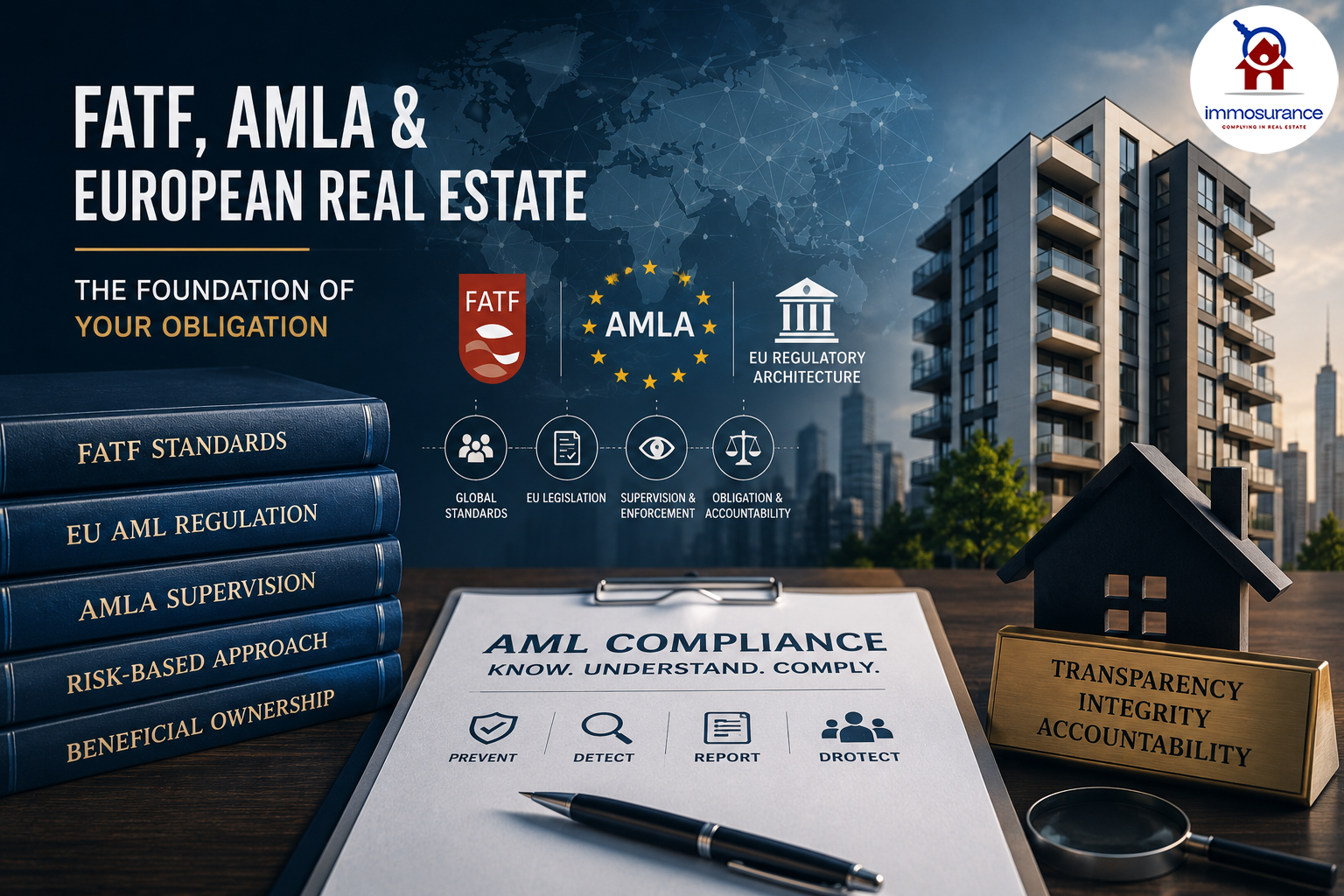
The Obligation to Know: Why Understanding the Framework Is Itself a Legal Requirement
There is a persistent and dangerous misconception in the European real estate sector: that compliance is a process performed by specialists somewhere in the back office, and that front-line professionals — agents, negotiators, developers, and their managers — need only a passing familiarity with the rules. This misconception is not merely operationally negligent. Under the incoming Anti-Money Laundering Regulation (AMLR), enforced by the newly operational European Anti-Money Laundering Authority (AMLA), it is legally indefensible.
The AMLR mandates that all employees of obliged entities — not merely dedicated compliance officers — receive regular, certified AML training. That requirement is meaningless without the foundational knowledge that makes such training comprehensible. To understand what AMLA requires, one must understand what AMLA is built upon. And to understand that, one must begin where the entire global framework begins: with the Financial Action Task Force.
Real estate businesses in Europe have been obliged entities under AML law since December 2001 — over twenty-five years. That is twenty-five years during which the sector should have been building institutional knowledge, embedding due diligence cultures, and developing robust internal frameworks. The arrival of AMLA does not grant a grace period for those who have not yet begun. It closes the door on delay entirely.
You cannot comply with a framework you do not understand. And in 2025, not understanding is no longer a defence — it is an aggravating factor.
The Financial Action Task Force: The Foundation Beneath European Law
The Financial Action Task Force (FATF) is the intergovernmental body that develops the international standards upon which every serious AML/CFT regime in the world — including the EU's — is built. Founded in 1989 and comprising 40 member jurisdictions representing the world's leading financial centres, FATF does not enforce rules directly. What it does is far more consequential: it defines what the rules must be.
FATF's Recommendations form a comprehensive framework for combating:
• Money laundering — the process of making criminal proceeds appear legitimate
• Terrorist financing — the channelling of funds, licit or illicit, to support terrorist activity
• Proliferation financing — the funding of weapons of mass destruction programmes in violation of international sanctions
• Emerging financial crime threats — encompassing digital assets, AI-enabled fraud, cyber-crime proceeds, and sanctions evasion
FATF's influence is not derived from a treaty obligation. It is derived from consequence: jurisdictions that fail to meet FATF standards are placed on grey or black lists, triggering heightened scrutiny from international counterparties, correspondent banking restrictions, and reputational damage that cascades through their entire financial sector. Every EU Member State is a FATF member or operates under a FATF-equivalent framework. Every EU AML directive and regulation is, at its core, a legislative translation of FATF standards into binding European law.
When you receive AMLA guidance, when you apply Customer Due Diligence procedures, when you file a Suspicious Transaction Report — you are operationalising frameworks that FATF designed. Understanding why those frameworks exist, and what they are designed to prevent, is what separates a genuinely compliant organisation from one that is merely processing paperwork.
What FATF Standards Shape — And Why Real Estate Is at the Centre
FATF's Recommendations shape the regulatory architecture across five critical dimensions, each of which directly determines what your real estate business is required to do:
AML/KYC Regulations
FATF Recommendation 10 requires obliged entities to conduct Customer Due Diligence — identifying and verifying the customer, identifying beneficial owners, and understanding the nature and purpose of the business relationship. This recommendation is the direct parent of the CDD requirements in the AMLR. For real estate businesses, this means knowing not just who signs a contract, but who ultimately owns or controls the buying or selling entity, and whether their funds are legitimate.
Beneficial Ownership Transparency
FATF has identified the real estate sector as a priority vehicle for money laundering precisely because of the opacity historically available through complex ownership structures: shell companies, nominee directors, multi-layered corporate chains, and trusts. FATF Recommendation 24 addresses transparency of legal persons, and the AMLR directly translates this into mandatory beneficial ownership identification and verification requirements for real estate transactions. The days of completing a transaction for a BVI company without probing through to the human being with ultimate control are over — under the AMLR, doing so is not merely sloppy practice; it is a regulatory violation.
Risk-Based Compliance Frameworks
The most operationally significant concept FATF has contributed to modern compliance is the Risk-Based Approach (RBA). Rather than applying identical scrutiny to every customer and transaction — an approach that would be both prohibitively expensive and analytically ineffective — the RBA requires institutions to assess risk at the enterprise level and at the customer level, and to direct proportionate resources and controls to proportionate risk.
FATF's formulation is precise: a domestic salary account and a complex offshore corporate structure used to acquire prime real estate in a major European city do not carry the same money laundering risk. They should not receive the same level of due diligence. The RBA requires — and the AMLR mandates — that higher-risk scenarios attract Enhanced Due Diligence. Lower-risk scenarios may justify Simplified Due Diligence, but only where the risk assessment genuinely supports that conclusion and is documented as such.
For real estate businesses, implementing the RBA means conducting a documented Enterprise-Wide Risk Assessment that identifies where in your business, geography, customer base, and transaction types the greatest financial crime risks lie. It means having a policy that prescribes what you do differently for a high-risk customer versus a standard one. It means training your staff to recognise the indicators that should elevate a transaction's risk rating. This is not abstract compliance theory — it is the operational minimum required under AMLA.
Financial Intelligence Sharing
FATF Recommendation 29 requires countries to establish Financial Intelligence Units (FIUs) — the national bodies that receive, analyse, and disseminate information on suspected money laundering and terrorist financing. Every Suspicious Transaction Report (STR) filed by your business goes to your national FIU, which correlates it with intelligence from other obliged entities and shares findings with law enforcement and counterpart FIUs across borders.
AMLA's central role in the new EU framework includes direct coordination of this FIU network. STRs are not bureaucratic formalities — they are intelligence inputs into a system that tracks serious organised crime across 27 Member States. A real estate business that fails to file where it should is not merely non-compliant; it is, knowingly or not, protecting a gap in the intelligence picture that criminals exploit.
Cross-Border Cooperation and Mutual Evaluations
FATF conducts Mutual Evaluations — rigorous, peer-reviewed assessments of each member jurisdiction on two dimensions: technical compliance (are the laws on the books?) and effectiveness (do the laws actually work in practice?). These evaluations have profound consequences: a poor effectiveness rating signals to the international financial community that a jurisdiction's AML controls cannot be trusted, triggering de-risking decisions by global banks and investors.
The European Commission and AMLA are acutely aware of Member State performance in FATF evaluations. Real estate is consistently identified in Mutual Evaluation Reports as a high-risk sector with chronically low STR filing rates and poor CDD quality. This is precisely why the real estate sector features so prominently in the AMLR's scope and why AMLA's supervisory attention will focus here. When a jurisdiction's real estate AML standards fail the FATF effectiveness test, the consequences fall on every business in that market.
Your national FATF Mutual Evaluation performance directly determines how intensely AMLA and your national supervisor will focus enforcement resources on your sector. Real estate is already in their sights. Training your people now is how you step out of that line of fire.
Emerging Threats: Why the Compliance Landscape Will Keep Evolving — And Why You Must Keep Pace
FATF's mandate extends beyond the typologies of traditional money laundering. As financial crime adapts to digital infrastructure, FATF — and by extension the AMLR — adapts with it. The emerging risk landscape that every real estate compliance professional must now understand includes:
• Digital assets and virtual currencies: increasingly used in real estate transactions in certain markets, carrying opacity risks that traditional due diligence frameworks were not designed to address.
• AI-driven fraud and identity manipulation: synthetic identity creation, deepfake verification bypass, and AI-generated documentation are emerging vectors that stress-test CDD processes dependent on human review.
• Sanctions evasion through real estate: the use of property acquisitions to circumvent international sanctions regimes is a growing FATF concern, directly relevant to European real estate markets given the post-2022 sanctions landscape.
• Cyber-enabled financial crime: the proceeds of cybercrime — ransomware, business email compromise, and large-scale fraud — are increasingly laundered through property transactions.
These are not distant risks. They are active typologies documented in FATF's own guidance papers and increasingly visible in the transaction patterns of European real estate markets. A compliance programme that addresses only the typologies of 2001 is not fit for 2025. Regular, updated employee training — mandated under the AMLR — is the mechanism by which your organisation stays current. It is also, under a supervisory inspection, the evidence that you take your obligations seriously.
From Global Standard to Binding European Law: The Chain from FATF to AMLA to Your Business
Understanding how FATF standards translate into your day-to-day obligations is not merely intellectually useful — it is what enables your compliance programme to be coherent rather than mechanical. The chain of authority runs as follows:
FATF sets the international standard — defining what risk-based AML frameworks must achieve, what CDD must include, what reporting obligations must look like, and how jurisdictions must be evaluated.
The EU translates FATF standards into law — historically through Directives (4AMLD, 5AMLD, 6AMLD) that required national transposition, now through the directly applicable AMLR that requires no transposition at all.
AMLA enforces the AMLR — directly supervising the highest-risk obliged entities, setting binding Regulatory Technical Standards, and coordinating with national supervisors across all 27 Member States.
Your business operationalises the requirements — through risk assessments, CDD programmes, ongoing monitoring, STR filing, trained staff, and robust governance.
The critical difference between the old framework and the new one is not the substance of the obligations — those have existed since 2001. The critical difference is enforcement. Under previous Directives, enforcement was filtered through national authorities of varying capacity and appetite. Under the AMLR, it is direct, uniform, and supranational. AMLA does not apply a lighter touch to sectors or jurisdictions that have historically under-enforced. It applies the standard.
The Training Imperative: Every Employee, Every Year, Without Exception
The AMLR's training requirement is explicit and non-negotiable: all employees of obliged entities must receive regular AML/CFT training appropriate to their role. This is not a recommendation. It is a compliance obligation, and failure to document and demonstrate it is a finding that supervisors are specifically instructed to pursue.
For real estate businesses, this means that every person who touches a transaction — every agent who conducts a viewing, every negotiator who structures a deal, every administrator who processes documentation, and every manager who supervises — must understand the following:
• What money laundering is, how it works, and why real estate is a preferred vehicle for it.
• What their personal obligations are — including the obligation to escalate internally and, where required, to report externally.
• What the red flags are in a real estate context — unusually structured transactions, cash payments, pressure to complete quickly, reluctance to provide documentation, or counterparties that do not match the profile of the transaction.
• How the FATF framework, EU law, and AMLA's supervisory authority connect to their daily work.
• What tipping off means and why disclosing an STR to the subject is a criminal offence.
Certification-based training — where completion is formally assessed and documented — is both best practice and the most defensible evidence of compliance in the event of a supervisory inspection. A business that cannot produce training records for all employees, current to within the past twelve months, is exposed. Under the AMLR, that exposure is not theoretical.
Why Knowledge Is Not Just a Compliance Requirement — It Is a Commercial Advantage
There is a compelling commercial argument for full AML literacy across your organisation that goes beyond the avoidance of sanctions. The real estate market is moving in a direction where the quality of your compliance programme is a signal of professional credibility — to institutional investors, to international clients, to partner firms, and to financial institutions whose correspondent relationships you depend upon.
An organisation whose staff are trained, whose CDD is documented, whose risk assessment is current, and whose governance structure is sound has a demonstrable advantage in attracting the clients who matter most — those operating in the formal, regulated economy with complex, high-value transactions. Conversely, a business that cannot demonstrate AML literacy will find itself increasingly shut out of partnerships, transactions, and markets where counterparties conduct their own due diligence.
Strong compliance frameworks do not merely protect institutions from criminal exploitation — they protect the integrity of the markets in which those institutions operate. A European real estate sector that genuinely implements FATF standards is a more trustworthy, more professionally respected, and ultimately more commercially valuable sector. Every business that meets the standard contributes to that environment. Every business that does not undermines it.
Conclusion: The Knowledge You Build Today Is the Defence You Will Need Tomorrow
FATF set the global standards. The EU translated them into binding law. AMLA will enforce them with a rigour and consistency the sector has never previously experienced. Your business has been an obliged entity for twenty-five years. The only question left is whether the knowledge, the culture, and the systems are in place to meet the standard — today, not at some notional point in the future when you have more time, more budget, or a more convenient regulatory climate.
That climate will not arrive. The direction of regulatory travel in Europe is unambiguous, and it does not include a reversal of AMLA's mandate or a relaxation of the AMLR's requirements. If anything, each FATF Mutual Evaluation cycle, each high-profile money laundering scandal in the property market, and each advance in financial crime typologies will intensify the focus on this sector.
The answer is not to wait and see. The answer is to build the knowledge, train the people, implement the frameworks, and demonstrate the culture that AMLA expects to find when it looks. Start with understanding the foundation — FATF, its purpose, its standards, and why they govern your daily professional life. Build outward from there to the specifics of the AMLR. And ensure that everyone in your organisation, from the newest recruit to the most senior partner, can articulate why compliance matters, what their personal role in it is, and what they do when they see something that does not look right.
Learn today. Because in compliance, ignorance is not a defence — it is an invitation.