THE TIME IS NOW
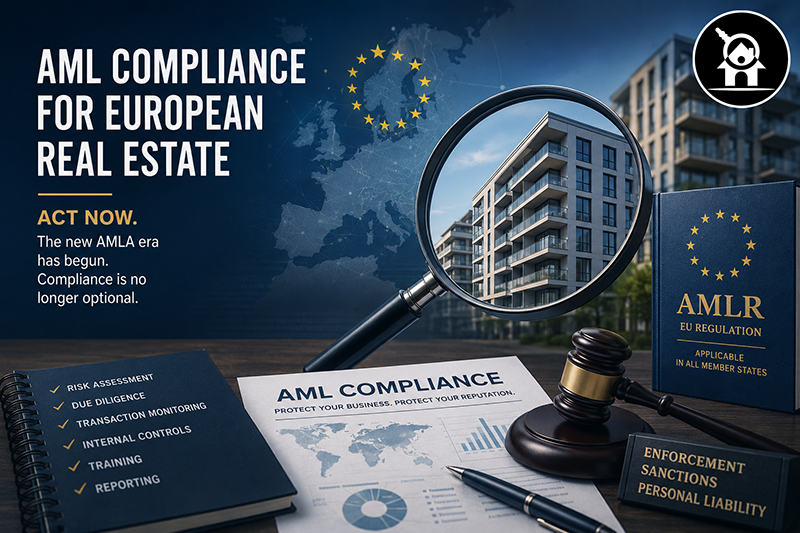
Why the Urgency? Because Waiting Is No Longer a Strategy
European real estate has long been identified by FATF, Europol, and national financial intelligence units (FIUs) as one of the highest-risk sectors for money laundering. Property transactions offer criminals precisely what they need: high-value assets, opacity in beneficial ownership, complex financing chains, and historically weak due diligence from intermediaries.
Until now, supervision resided with national competent authorities whose resources, priorities, and enforcement rigour varied enormously across the EU. Some businesses — particularly smaller agencies and regional developers — operated for years without ever being subjected to a meaningful AML inspection. This is not a compliment to the sector's integrity; it is an indictment of a supervision gap that AMLA was explicitly created to close.
With AMLA operational and the AMLR directly binding across all Member States, the following changes are not hypothetical — they are the current legal reality:
• A single, harmonised rulebook applies identically in Madrid, Warsaw, Lisbon, Vienna, and Amsterdam. There is no longer a race to the bottom.
• AMLA holds direct supervisory authority over high-risk obliged entities and sets binding technical standards for all others.
• Fines under the AMLR can reach €10 million or 10% of annual turnover for serious, repeated, or systematic violations — whichever is higher.
• Public naming decisions can be published by supervisory authorities, triggering reputational destruction overnight.
• Senior management and beneficial owners of non-compliant entities face personal liability, including temporary bans from exercising management functions.
The question is no longer whether your business will be scrutinised. The question is whether you will be prepared when it is.
A Paradigm Shift: From National Patchwork to EU-Wide Enforcement
The Fourth and Fifth Anti-Money Laundering Directives required Member States to implement AML measures but left substantial room for interpretation, delayed transposition, and uneven application. National FIUs operated in relative isolation. Cross-border coordination was aspirational rather than operational.
The new architecture is categorically different. The AMLR is a Regulation — not a Directive. It does not need to be transposed. It does not pass through national filters. It applies directly, uniformly, and simultaneously across every Member State the moment it enters into force. AMLA, headquartered in Frankfurt and operational since 2025, coordinates with national FIUs through their system and exercises direct supervisory competence over the riskiest obliged entities identified at EU level.
For real estate businesses, this means that regulatory arbitrage — the informal practice of exploiting lighter-touch national regimes — is structurally impossible under the new framework. The standard is the same in every jurisdiction. The enforcement will be equally vigorous in every jurisdiction. The excuses have run out.
The Six Pillars of AML Compliance: What Full Conformity Demands
Full compliance under the AMLR is not a tick-box exercise. It requires a living, embedded, risk-intelligent framework across six interlocking pillars. A weakness in any single pillar creates systemic exposure — supervisors are trained to identify precisely these gaps.
Pillar 1 — Enterprise-Wide Risk Assessment (KYB)
The foundation of any defensible AML programme is a rigorous, documented, and periodically reviewed Enterprise-Wide Risk Assessment (EWRA). This is not a generic template: it must reflect the specific risk profile of your business — encompassing your customer base, the geographies of both parties and properties involved, the nature and complexity of your transaction types, your distribution channels, and your exposure to high-risk indicators such as politically exposed persons (PEPs), cash-intensive transactions, or cross-border structures.
The EWRA must be formally approved by senior management, documented in the entity's AML Policy, and serve as the foundation upon which all controls are designed and calibrated. A static document prepared years ago and never revisited is not compliant — it is evidence of negligence.
Pillar 2 — Customer Due Diligence (KYC)
Customer Due Diligence (CDD) sits at the operational heart of AML compliance. Every customer relationship in the real estate sector must be subject to a structured, documented onboarding process that includes identity verification, beneficial ownership identification, and a customer risk rating. The obligation extends, where applicable, to the seller, the beneficial owner, and any associated intermediaries.
The risk-based approach mandated by the AMLR requires real estate businesses to apply Enhanced Due Diligence (EDD) to high-risk customers without exception — including PEPs, customers from high-risk third countries, and transactions exhibiting red flags. Simplified CDD is permissible only where the risk assessment genuinely supports it and that assessment is documented. Assumptions of low risk without evidential basis are not acceptable and are a primary finding in enforcement actions.
The five components of a compliant CDD process are: (1) data collection and identity verification; (2) adverse media and sanctions screening; (3) customer risk profiling and rating; (4) ongoing monitoring of the business relationship; and (5) systematic record retention. All five must function in concert.
Pillar 3 — Ongoing Monitoring of Transactions and Business Relationships
AML compliance does not end at onboarding. The obligation to monitor continues throughout every business relationship. Transactions must be assessed for consistency with the customer's known profile, risk rating, and stated purpose. Anomalies — in transaction size, frequency, counterparty, or financing structure — must trigger a documented review process.
Particular vigilance is required regarding structuring: the deliberate fragmentation of large transactions into smaller amounts to evade detection thresholds. This technique is prevalent in real estate markets. Failure to detect and report structured transactions exposes the obliged entity to the full weight of regulatory sanction, including criminal liability in aggravated cases.
Pillar 4 — Suspicious Transaction/Activity Reporting (STR/SAR)
The obligation to file Suspicious Transaction Reports (STRs) with the competent national FIU has been a cornerstone of the EU AML framework since 2001. Yet reporting rates from the real estate sector remain disproportionately low relative to the sector's identified risk level — a discrepancy that regulators interpret not as evidence of a clean market, but of inadequate detection and a cultural reluctance to report.
Under the AMLR, the reporting obligation is absolute. The AML Policy must define the internal escalation path: who observes, who escalates internally, within what timeframe, with what documentation, and through which channel to the FIU. Failure to report a suspicious transaction — when the grounds for suspicion were or should have been apparent — constitutes a regulatory violation in its own right.
Pillar 5 — Ongoing Employee Training and Certification
A compliance framework is only as effective as the people operating it. The AMLR mandates that all employees — from front-line agents to senior management — receive regular, role-appropriate AML training. This training must be documented, must cover the entity's specific risk profile and red flag indicators, and must be refreshed when the regulatory landscape or the entity's risk profile changes.
Certification-based training programmes provide the most defensible audit trail. An employee who cannot demonstrate awareness of their AML obligations at the moment a suspicious transaction occurs is not only a compliance liability — they are a potential vector for criminal exploitation.
Pillar 6 — AML Governance, Oversight, and Record-Keeping
Governance is the spine of the compliance framework. Every obliged entity must appoint a qualified AML Principal Officer with clearly defined authority, accountability, and direct access to senior management. The AML Policy must carry formal board-level approval. High-risk customer onboarding must receive senior management sign-off. An independent audit function must periodically test the adequacy of the entire AML programme.
Record-keeping is not administrative housekeeping — it is a legal obligation and the primary evidence base during supervisory examinations. Records of risk assessments, CDD documents, transaction data, internal escalation notes, and STRs filed must be retained for a minimum of five years in an organised, retrievable format. Gaps in records are treated by supervisors as gaps in compliance.
The True Cost of Non-Compliance: It Is Not Just a Fine
Business leaders sometimes approach AML compliance as a cost-benefit calculation: the probability of an inspection multiplied by the expected fine, weighed against the operational cost of full compliance. This framing is not only legally indefensible — it is commercially catastrophic in the AMLA era. Consider the full spectrum of consequences that flow from a serious compliance failure:
• Administrative sanctions: Fines of up to €10 million or 10% of annual group turnover for systematic violations — a potentially existential event for most agencies.
• Criminal referral: Where wilful blindness or facilitation of money laundering is established, senior managers and beneficial owners face criminal prosecution under national law.
• Public disclosure: Supervisory authorities are empowered to publish enforcement decisions. The reputational consequences of a public AML sanction in the real estate sector are permanent and severe.
• Business prohibition: AMLA and national supervisors can issue temporary or permanent prohibitions on specific individuals from holding management positions within obliged entities.
• Commercial cascade: Financial institutions, co-brokers, and institutional partners may terminate relationships with non-compliant entities, triggering cascading commercial losses.
Building Your Compliance Programme: A Structured Path Forward
The path to full compliance is clear. What it requires is not extraordinary resources — it requires will, structure, and immediacy. The following five-step implementation approach provides a defensible roadmap:
Step 1 — Regulatory Mapping: Conduct a gap analysis between your current AML posture and the requirements of the AMLR. Identify which obligations are partially met and which are absent entirely.
Step 2 — Enterprise-Wide Risk Assessment: Commission a formal, documented EWRA tailored to your specific business profile. This is the foundation upon which every subsequent control is built.
Step 3 — Policy and Procedure Development: Develop or overhaul your AML Policy and supporting procedures to reflect AMLR requirements and your risk assessment outcomes. Secure board-level approval.
Step 4 — Training and Certification: Roll out a structured, certified training programme across all staff levels. Maintain verifiable completion records. Build this into annual HR governance.
Step 5 — Audit and Continuous Improvement: Establish an independent audit cycle for your AML framework. Test your controls, review your risk assessment annually, and update your policies when the landscape shifts. Compliance is not a project — it is a programme.
Conclusion: Compliance Is the Price of Operating in the European Market
The European real estate sector has had twenty-five years to internalise its AML obligations. The arrival of AMLA and the AMLR does not introduce those obligations — it enforces them with a rigour, consistency, and reach that was previously absent. The window for delay, for minimal effort, and for hoping to remain beneath the supervisory horizon has closed.
Real estate businesses that act now — that invest in robust risk assessments, comprehensive due diligence processes, trained and aware staff, and sound governance — will not merely avoid sanctions. They will build a platform of institutional trust and professional credibility that differentiates them in an increasingly scrutinised marketplace. Institutional investors, international clients, and major financial partners are themselves subject to rigorous AML obligations; they will not and cannot work with counterparties who are not.
The choice before the European real estate sector is not between compliance and commercial freedom. It is between acting today and bearing the full consequences of acting too late.
Act today. The regulatory clock does not pause for those who are not yet ready.