Suspicious Activity Reports
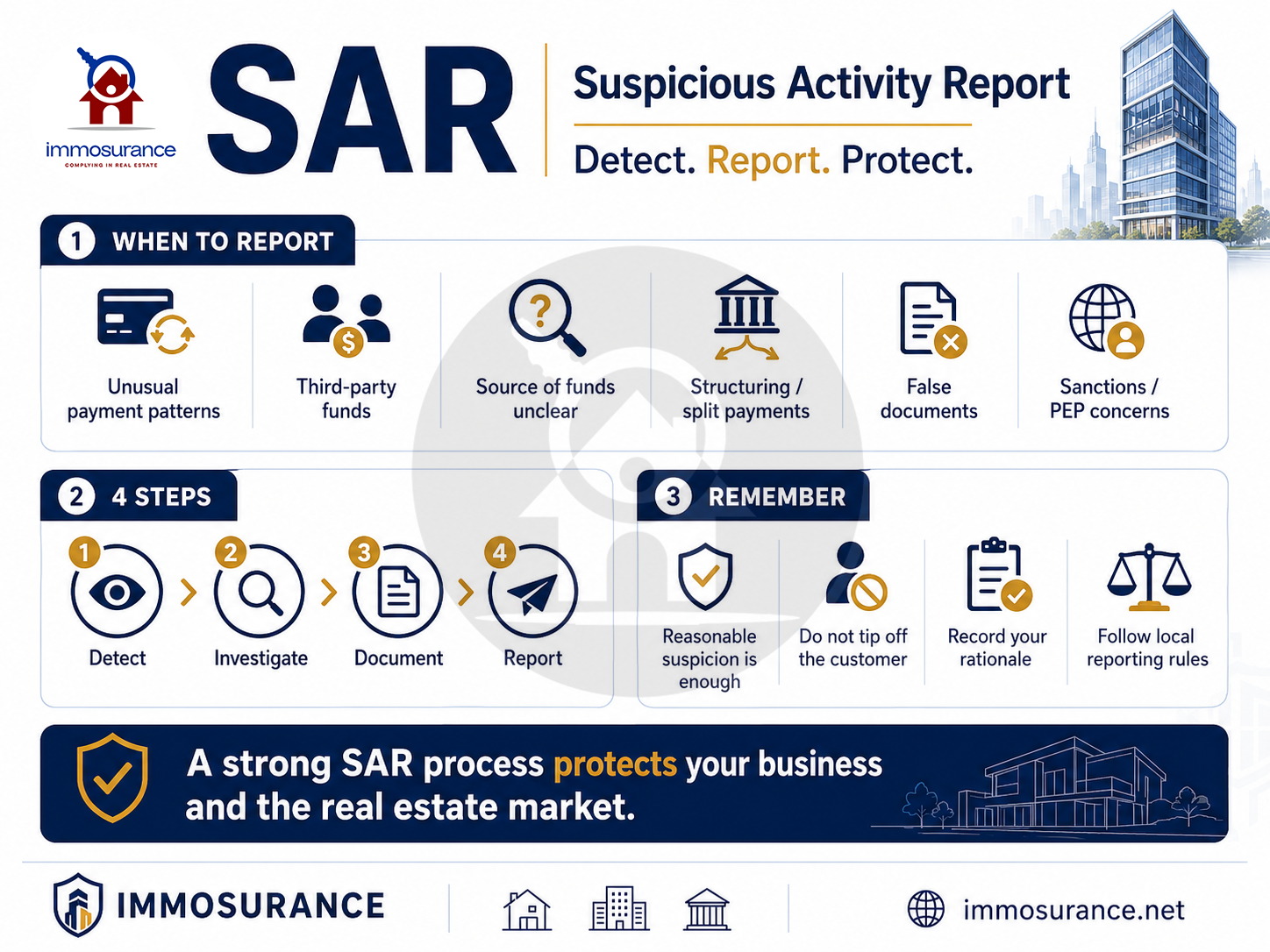
For AML compliance professionals working in the real estate sector, one of the most powerful instruments for detecting and disrupting that activity is the Suspicious Activity Report, or SAR.
Understanding what a SAR is, when to file one, and how to do it well is not just a regulatory requirement — it is a professional responsibility that sits at the very heart of effective financial crime prevention.
## What Is a Suspicious Activity Report?
A Suspicious Activity Report is a formal disclosure submitted by a regulated entity — such as a real estate agent, notary, or property developer — to the relevant financial intelligence unit (FIU) whenever they have a reasonable suspicion that a client, counterparty, or transaction may be connected to money laundering, terrorist financing, or another financial crime.
In many jurisdictions, the obligation to file a SAR (sometimes referred to as a Suspicious Transaction Report, or STR) is a legal requirement, not a discretionary act. Failure to report — or, equally, tipping off a client that a report has been made — can expose both the individual professional and their organisation to serious sanctions.
## What Triggers a SAR?
No two cases are identical, and suspicious activity rarely fits a single template. That said, AML professionals have identified a number of consistent behavioural and transactional patterns that warrant closer scrutiny — and often a SAR filing.
Common triggers include:
Unusual transaction patterns — activity that deviates from a client's known profile, history, or stated purpose without a plausible explanation.
Structuring and smurfing — the deliberate breaking up of large transactions into smaller amounts to avoid detection thresholds.
Mule account activity — accounts used as intermediaries to move funds on behalf of third parties, often without the apparent knowledge or benefit of the nominal account holder.
Sudden high-value transfers — large movements of funds, particularly to or from high-risk jurisdictions, that appear inconsistent with the client's background or the nature of the transaction.
Identity theft and synthetic identities — the use of falsified, stolen, or manufactured identities to conduct transactions or establish relationships.
Sanctions evasion indicators — signs that a party to a transaction may be attempting to circumvent sanctions, including the use of complex ownership structures, front companies, or opaque beneficial ownership arrangements.
Dormant accounts becoming suddenly active — accounts with little or no prior activity that suddenly show significant transaction volumes, particularly when the source of funds cannot be readily established.
In the real estate sector specifically, additional red flags include all-cash transactions without a clear funding source, property purchases through multiple layers of corporate entities, and transactions where the purchase price appears significantly above or below market value.
## How to File a Strong SAR
The quality of a SAR matters as much as the decision to file one. A well-constructed report gives investigators actionable information; a poorly constructed one creates noise without clarity.
The most effective SARs share several characteristics. They are grounded in observable facts and documented evidence, not speculation or assumptions about intent. They tell a clear, chronological narrative — describing what happened, when, and why it raised concern. They apply the reasonable suspicion standard consistently, meaning the threshold for reporting is genuine concern based on observable indicators, not certainty of wrongdoing.
Key principles for AML professionals to keep in mind:
- Focus on behaviour and evidence, not assumptions about motive
- Maintain thorough documentation of all observations, client interactions, and due diligence steps taken
- Escalate through the appropriate internal compliance channels before filing externally
- Never tip off the subject of a report — doing so is a criminal offence in most jurisdictions and can seriously compromise an investigation
- File promptly — delayed reporting reduces the value of financial intelligence and may itself constitute a breach of regulatory obligations
## Why SAR Filing Matters
SARs do not exist in isolation. When filed correctly and in a timely manner, they feed into a broader intelligence network that helps authorities identify, track, and disrupt serious financial crime — including money laundering, fraud, terrorist financing, and financial abuse targeting vulnerable individuals.
For the real estate sector, which remains one of the most attractive vehicles for laundering large amounts of criminal proceeds, a culture of rigorous transaction monitoring and disciplined SAR filing is not merely a compliance exercise. It is an active contribution to the integrity of property markets and the protection of legitimate buyers, sellers, and investors.
## How Immosurance Supports Your SAR and AML Obligations
Meeting these obligations consistently — across a busy caseload, in a complex regulatory environment, with ever-evolving criminal typologies — is a significant challenge. That is where Immosurance makes a measurable difference.
Immosurance is the all-in-one, GDPR-compliant AML compliance solution built specifically for the real estate industry. It is designed to help professionals not only identify potential candidates for SAR and STR reporting, but to do so with the speed, accuracy, and audit trail that modern compliance demands.
And the platform does not stand still. Immosurance is actively evolving toward direct integration with the electronic reporting gateways of the relevant authorities — meaning that, in time, the entire SAR filing workflow, from initial alert to official submission, will be managed within a single secure environment...so stay tuned!
For real estate professionals who take their AML responsibilities seriously, that is not just a convenience. It is a competitive and compliance advantage.
---
*Immosurance is the secure, GDPR-compliant AML solution for the real estate sector.